
It had been a long, hot day. The Malagasy team I was working with and I had been helping the local residents who lived on a long-defunct former French colonist’s tobacco plantation establish some improved gardens for the residents of a large Toby (a special type of Malagasy village I’ll describe in a later post) about 50 km inland from 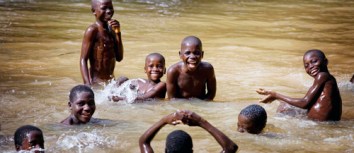 Morondava, which is on the west coast of Madagascar. It had been a hot and dusty day and we’d been hauling cow dung from a nearby pen for the gardens. Of the things we had to work with (not much), we’d found that using <<sobika>> (straw baskets) worked best for hauling and I’d found putting it on your head to haul it was a lot easier than trying to carry it. On the other hand the dung was dry and dusty and some worked it’s way through the sobika and down over me. Being the only <<fotsy oditra>> (white-skinned) person in the group, who also sweat a great deal, whether I was working or not, by the end of the day I had a second “skin” of what had worked its way through the sobika.
This was a very simple town, with at that time no well (though we were able to help them dig one later), so the nearest water source was the big, shallow, very muddy river that flowed down to the ocean from the highlands that was just a couple hundred meters away from the village. Or a bucket. But this seemed to be a lot bigger job than a bucket. So it was down to the river for me. But it turned out to be a “ride,” not just any walk.
One of the residents of this Toby was a young man with some special needs. Though about my age (mid-20s), he spent much of his days pretending he was driving a bush taxi, steering an imaginary steering wheel, providing the motor sound as he “drove” back and forth through the Toby, inviting us all in for the “ride.” Hearing I was headed to the river, he offered to “drive” me down. So I got “in” his “taxi” and we were off, complete with his shifting of gears as necessary.
Arriving at the river, I immediately had second thoughts about it all. The river was not very deep and very muddy. But looking down at what I was covered with, I decided some mud was better than that, so into the river we went. Walking out a ways, one then just sat down and used the water flowing by to do the washing. And the red mud in the water actually helped clean me off. Other than talking about his “taxi,” my friend didn’t say much, so we didn’t talk, just enjoyed the water, which, though warm, was still cooler than the air. And amazingly, as red as the water was, we came out clean, or at least I was a lot cleaner than I’d been going in.
And then it was time to get back “into” the “taxi” and “ride” back to the village, with a lot of shifting of “gears” (my “driver” told me I was an exceptually heavy load). Arriving back at the village, I used a bit of the bucket of water for some rinsing.
Rejoining those I had been working with that day, all who had stayed much cleaner than me, I realized they were actually very relieved I’d been down to the river!
I was fortunate to have grown up in Madagascar during a time when it was much safer than it is now. My last year or two in high school there, some friends and I decided it would be fun to ride bike up to Tsivory, a town I’d actually never been to. We figured about a day and half ride so left about noon. Taking a “shortcut” we were soon dealing with flat tires as it wasn’t driven on enough to keep it clear of the thorns which were puncturing them. My brother had 5 or so alone. Each time meant stopping, taking the tire off the bike, the inner tube out of the tire, identify and patch the hole and then repeat the process. So we didn’t get as far as we’d hoped the first day. It was growing dark, so we decided to set up our tents on the top of a grassy hillside. Then, as we were doing this, a man from a nearby village came over and convinced us to not camp out for the night, but rather stay with him. This was not a small thing as it meant he’d not be sleeping in his house as he was giving it to us for the night. And not only that, but in honor of our staying with them, they killed a goat for the rice they also served us. This all took quite awhile, but we weren’t going anywhere.
When it was time to eat, they brought a giant bowl of rice, the cooked goat and greens. A feast i that part of the world. We stayed where we were, sitting on the floor around the edges of the small house we’d been given for the night. By the light of kerosene lamps made out of recycled sweet milk tins we ate hungrily. The elder ate with us, watching us closely. There wasn’t a great deal of talk as our host spoke no English and only my brother spoke much Malagasy
We were thirsty as we weren’t carrying enough water. We had a filter with us, but most of the streams we’d crossed over were dry and we’d also had to use some of our water to find the holes in our tires (a total of about 10 that first day). [Why we hadn’t a sked our hosts for some water to filter for drinking, I don’t know.] One of my friends, seeing what appeared to be a bottle of water in the middle of the floor eagerly poured some of it into his cup and took a big gulp. Silence. Then a gasp and a whole lot of coughing on his part that went on for some time. “Tsy rano ity!” he finally managed to get out, which meant “This isn’t water!” No, it wasn’t. In fact it was “toaka,” a very high proof of home made alcohol, most likely made from distilled sugar cane or bananas, also provided to us in honor or our visit. The elder had watched this all happen and began to laugh quietly. “Tsy rano ity!” he said and kept on saying the rest of the meal. It took awhile, as it had been quite a “shot” of alcohol he’d swallowed, but eventually our friend also laughed with him.
None of the rest of us touched the bottle the rest of the night, though the elder enjoyed some of it.
To this day, now some 40 years later, the phrase “” gets a wry smile from my friend.
One of the things I had not planned on in this life of mine was to be anything less than spectacular in the jobs I had in life. This has not been the case, at least according to some of the people I’ve worked with. And why is this? There certainly were a variety of things going on in every case. Enough that it’s taken me some time to sort through them all well enough to at least make some sense of it all. There’s also some of my own realities that I’ve had to first figure out (with the help of some wise souls) and slowly work on. Actually, at times I’ve worked on them very hard, but I find progress has been slow. More like obtaining wisdom than any quick fix sort of thing. And humility. I’ve found it not always easy to come to grips with the reality of who I am and have become as I’ve moved through life lo now for over half a century. For someone who never planned on being laid off, this has now happened several times.
So as I ponder what comes next (which I’ve learned to put a much shorter timeline on), I feel one of the things I bring is the wisdom from having had to experience things I had not sought, of “being on a journey I had not planned on” as I said to try to describe it all as one of the jobs I’ve had came to a sudden, unexpected and very disappointing end. In a world that emphasizes one success after another, onward and upward, achievement, etc., I know some of this. But I also know what failure feels like. What it means to be really, really disappointed. What it means to find oneself in deep hole and then having to figure out how to crawl out of it. Where to go for help and then struggling with the challenge of making use of it. What happens when it feels like you’ve lost your resilience and then figuring out how to work on getting it back again.
I try to remember this in the teaching I do. I also have this to bring to what comes next.
Which is the question I’m seeking answers to at this point. Again.
At one point fairly early in our time working in Madagascar I was asked whether I could bring a few things along with me on a trip to Vangaindrano, where we were doing some training. It turned out to be fresh cream, amongst several other things, for a Norwegian (NMS) single mademoiselle missionary living/working there who was having her 50th birthday, which is evidently a big deal for Norwegians. Packing the cream in the middle of my duffle bag and hoping for the best, I headed out to the airport where I got on one of Air Madagascar’s twin engine Twin Otters, the most amazing of planes equally at ho me in the snowy icelands of northern Canada and the dusty plains of Africa. After stops in Mananjary and Manakara on the east coast of Madagascar, I got off on a grass airstrip outside the town of Farafangana. So far so good. Hopping a cab into town, I had them take me to the taxi-brousse (“brush taxi” as in bus) station. As luck would have it, there was a white Super Goulet (about a 20 passenger bus that at times could hold as many as 50 or more) loading up. After not waiting very long, it was time to leave. Great! And the bus wasn’t even that full! I congratulated myself (a bit too early as it turned out) on the wisdom of flying down in about a half day vs. the 2 day drive it was.
However, as the bus began to move, it was clear that all was not well. Seated over the back a xle, I ended up with a ring side seat on the most awful of grinding noises below me, what turned out to be the shredding of the differential. Assuming we would stop for repairs, I watched in surprise as we headed out of town, south on the 75km drive to Vangaindrano. While we started out at a reasonable 30 mph or so, over time the noise grew louder and the speed slower, with hills especially problematic. Till finally, still 10km or so from Vangaindrano, we literally ground to a halt just part way up a pretty good sized hill. So now what to do?
There quite a few of us men on this bus, so the first attempt was to see if we could push it up the hill. Before then I’d only had a very few experiences trying to push a bus, and never up a hill. Let’s just say this idea didn’t work very well. Now what? A Land Rover came by about this point, headed the same direction. For reasons I’ll never understand, they agreed to pull us into town. Keep in mind Land Rovers of that era were really not very impressive vehicles, made out of aluminum. Someone found a rope, which, after breaking several times, was doubled up enough times so it didn’t. And then the slow ride up the hill–for the bus. We all walked behind which was a good idea as well before the top of the hill the Land Rover was wheezing, with smoke coming out of places it shouldn’t. So our pull into town ended up just being a pull up the one hill, with the Land Rover left wounded. So we parted ways, but the driver was still happy, telling us all to get back into the bus as it was now all downhill to Vangaindrano. So we did and the driver put the gear in neutral and we were off, increasing speed till we were careening around corners in our top-heavy busy as the driver didn’t want to use his brakes so he could coast as far as possible on the flat lands leading into town. More thrilling than a roller coaster ride, even I was soon screaming as we went around curves with increasing speed.
And then we were on the flatlands that lead into town from the north, all of us guessing how far this thing would roll. As it turned out, not far enough. However, a kind man helped me with my duffle bag, carrying it all the way into town for me. Where I delivered the fresh cream, which amazingly, now some 8+ hours later, was still cool.
The mademoiselle made a surprising number of Norwegian cakes with the cream and a few other things I’d brought for her party the next day.
I was invited
and
they were wonderful.
so I have ended up with quite the mix of feeds on FaceBook. while I enjoy most of them most of the time, there are a subset determined to tell me
1) what to major in to make the most money–still isn’t of any interest to me,
and b) how to make a LOT of money–I’ve pretty much conclusively demonstrated through the years that 2) that’s not one of my gifts and c) it aint happening no how no way and now the best ones,
and 3) what you need to do if you’re “only a millionaire” who just hasn’t figured out yet how to become a billionaire. only way even the “millionaire” part of that equation is happening is if we switch what you’ve got millions of from US$ to Malagasy francs (MGF), where it’s now over 15,000 MGF per dolla (i’m old enough to remember back in the late ’60s when it was about 200 MGF per US$). and really, a) doesn’t the world already have enough if not too many millionaires and billionaires?! and 2) why would I ever want to be a member of something where Trump is one of those you end up rubbing shoulders with?!

I still remember a lecture in high school English that encouraged us to “hitch our wagons to a star.” Somewhere about that time I was suddenly much more aware of the injustices of the world I was growing up in the middle of while living in absolutely beautiful (nature-wise) town of what was then still called Fort Dauphin (now Tolagnaro), Madagascar, given the poverty so many people were faced with. And then I met someone from Church World Service who was just visiting our corner of the island. Asking him what he did, he told me it was a variety of things, but mainly helping provide shallow wells in another part of Madagascar. Asking him what training he had for this, he said he was a Civil Engineer. And so then and there I thought I’d figured out what I was going to be when I grew up.

I started at the little Lutheran college of Augsburg in pre-engineering and labored my way through one math, chemistry and physics course after another. After two years of this I transferred to the U of Minnesota where my engineering courses began. Several years later, now half way through a Masters in what was then called Agricultural Engineering (I was focusing on what then was called “Appropriate Technology” for any of you who remember that), I realized with a bit of a start that
1) I actually was probably never going to enjoy math as much as I needed to if I was going to be an engineer for a living and
2) I was more interested in the interface between engineering and people than in the engineering itself.
I shared this with my advisor who said that was all fine and well, but that this close to finishing my Masters, I needed to finish this first. It was great advice. As I neared completion of this degree my wife and I were invited (understood as “Called” within the Christian faith I seek to follow) by the Malagasy Lutheran Church to work in Madagascar, something the then still existing American Lutheran Church sought to support. So I finished school, my wife finished up her teaching, we sold most of what we had and moved to Madagascar in December 1982. While it took a few years to sort things out once there, over the next 10 plus years I very, very much enjoyed the realities of working cross-culturally in mostly another language (Malagasy with bits and pieces of French included in the mix) with a variety of gifted Malagasy colleagues as we sought to be of assistance to some of the poorest of those living in rural Madagascar. In so doing I moved from the engineering side of things to focusing on the broader challenges of community and leadership and eventually organizational development. Not so much theoretically as day-to-day, with the theory sort of collecting in “puddles” of wisdom over time. I had found my Calling.
And then very suddenly it ended. Our youngest almost died from a very severe asthma attack while I was away on tournée (french for “Safari”) and two weeks later we were back in the US per our doctor’s request and a month after that doctors in the US told us we would not be able to return to Madagascar.
And thus became a whole series of what at times have felt like unending transitions and questions that for me are still going on, now some 20 years later. Much of it based on vocation, though it’s quite a bit more difficult than that. I often describe it as my Tigger (of Winnie the Pooh) story, of when Tigger sought to figure out what Tiggers do best?!
I started not so long after we came home to the US in 1995 in the area of evaluating and researching various types of positive youth development programs. Which after 5 years transitioned into higher ed, which I’ve been doing now since 2000, teaching mostly in grad (Masters) programs in Leadership and Management. Which, as noted below, I’ve done with varying degrees of successes and failures.
Since I was let go from my last full-time faculty position in 2010 (downsizing–higher ed is in quite a lot of transition these days), I’ve been teaching part-time, unsuccessfully (thus far which feels like forever) getting back into nonprofit work. When asked these days what I do, my reply, an attempt at humor, is, “I teach. Allegedly. As not all my students agree with this statement.” Actually, I what I seek to do is facilitate learning opportunities with my students, some days with more success than others.

Is this my new calling? Or even my Calling?! So far the most honest answer I can give is “sort of.” When we found out we had to leave for the US in about a week way back in 1995, most likely not to return, I went to my mentor, a very wise Malagasy colleague named Razafimandimby. He listened to what I had to say and gave me some of the best advice I’ve ever received. He said that he believed I had been Called to Madagascar to work alongside my Malagasy colleagues these past 10+ years. That he had watched me attempt to respond to this Call (again, some days with more success than others). But I was not only Called to my work, but I was also Called to my family. And it was time for the latter to take precedence over the former. And so that’s been my primary Calling for these past 20 years. During which time I’ve also been seeking to better understand and find my niche here in this oh so complex US world (Minnesota version).
[several yrs ago (2008?) while I was visiting Tolagnaro, I was asked for some reflections on my time living in that town. This is a somewhat edited and expanded version of that]
As the age of 60 is no longer so far down the road, here I am with almost 50 years of memories  of this dear little town that used to be called Fort Dauphin and now is known as Faradofay (Malagasy for “Fort Dauphin”) or Tolanaro or Tolagnaro (my favorite) or even Taolagnaro.
How do I have this many years of memories of that town? By moving there when I was only 8, living there from 1966 to 1976 (while my parents taught at the American School which used to be there), visiting there pretty much yearly (with a few exceptions) from 1982 to 1995 and now having visited there 4 more times in the last 10 years or so.
During the time I lived in Fort Dauphin there was an American School and MCH dormitory for (mostly) Lutheran missionary kids located at what is now the Mahavoky Hotel campus, with about 50 to a high of 80 kids there in the school (1st through 12th grades) at any one time.
While my wife and I lived and worked in Madagascar it was watching the school and dorm eventually be moved to first Antsirabe, then, the school closed, the dorm was moved to Tana for several years, the few remaining kids going to the American School of Antananarivo.
So what are some of my memories of those years?
It’s having watched the Malagasy government from the days of the first President Tsiranana in the 1960s, who loved to come down and stay by Libanona beach, through many political changes in the early to mid-1970s, back when Ratsiraka was a young man…
It’s having driven on the road to Amboasary when it was newly paved and when the road from there to Ambovombe was a slash of red sand and clay through the Androy countryside.
It’s having watched a movie of the Apollo moon landing while lying on a <<tsihy>> (woven mat) in the moonlight in the front yard of what was then the MCH.
It’s remembering a time when what was then called Lebanon (now Libanona) was full of American Lutheran missionaries and their families every January, of remembering when there really wasn’t any tourism in Fort Dauphin and Berenty was mostly a place for the people who lived and worked there and the occasional American graduate student doing research for their doctoral studies.
It goes back to before the Catholic Cathedral was built, to a time when Fort Dauphin had a busy, mostly French Club Nautique (which we called the “Yacht Club”) at the Lanirano lake. When you walked in the shade of <<filao>> (long-needled pine) trees pretty much from the top of Nakling hill all the way down to the beach (before the cyclone of 1975). When the now abandoned Libanona motel was being built and the French Foreign Legion used to drive down from Antsirananana(?!) on training exercises, camping on the Lebanon rock beach.
A time when there were probably 50 or more French families living in town involved with sisal, fishing, running French companies, etc.
It was a time before 4x4s were necessary, when the road were such you could pick up a VW bug in Toamasina and easily drive it down to Toliary and then across to Fort Dauphin.
A time when there were only half the people living in the Anosy area and two or three times the forests.
During my last several visits there, it’s now become the reality of meeting the adult men who were the sons of the <<Karana>> shop keepers my parents bought things from, who now, like their fathers, still stand in the doors of their stores, watching the world move by.
It’s the reality of guards and their families still sleeping in lean-tos outside of stores, of cooked <<bageda>> (form of sweet potato) and giant bananas still for sale along the street, and small piles of charcoal and roasted peanuts, which sadly have become both much smaller and more expensive.
It’s still the sound of dogs barking at night, of up to very heated conversations during the day, of moonlight so bright and clear you can read by it…and the list goes on.
And it’s now some big changes, many of them related to the massive ilmenite mining operation whose structures and electric lights now surround Tolagnaro, from the mine and processing facilities north of the Lanirano lake to housing near Bezavona to more housing and a brand new harbor across the bay from the Libanona swimming beach.
It’s so many more people, so many of them so very, very poor.
It’s the now “old” harbor, standing mostly empty, with a brand new one located out at Whale Point.
It’s still some of the same 4TL taxis running around town, rebuilt Lord only knows how many times.
It’s so many fewer trees in almost every direction.
It’s a pretty much destroyed road from Tolagnaro at least as far as Amboasary.
And yet it’s still a raw beauty of hills and ocean and white sand beaches and palm trees and filao, whistling in the wind.
And the people who live here, as stoic to the hardships they face as they are friendly.
And it’s a whole lot of memories, most of them good, for which I am very thankful.
Just returned from a quick trip north to a Board meeting of a Lutheran camp our church makes use of (as in about 100 of our youth went there this summer). That was yesterday. I was able to stay over and slept (sort of) in a cabin right on the lake. While I didn’t hear any loons, I did get to see an incredible sunrise, starting about 430 this morning when it started to get light in the east across the lake. Then I had the opportunity to ride along as our high school youth came in from having camped in what I still call the BWCA (they added a letter to this at some point, as in “W” for “Wilderness”?
As our youth paddled in and then started telling tales of their time in the wilderness, I reflected on the energy and
excitement they still had, having paddled, portaged and slept in tents for a week. I had that once, too. It doesn’t seem almost 40 years since I worked at Wilderness Canoe Base one summer. But it is. Is this good or bad or somewhere in between? Yes.
One thing I’m grateful for is all the time we had with our kids as they were growing up, at least partly because we were living in Madagascar for about half of that time. It ended up now in retrospect going by so fast. Yet it was over 25 years. I figured out the other day that this is where the time between being young and now being old(er) went. Was it worth it? Most definitely. Would I do it that way all over again? Well, hopefully better, but yes, that was what we were called to be doing at that time. Now we’re blessed to be able to be a part of our grandchildren’s lives. How amazing is that?!
And now, as I try to be helpful and supportive of our church’s youth, I have the benefit of so many good memories my wife and I had with our children. As well as new experiences with the amazing youth our church is blessed with.
In having spent a fair amount of time away from home, “en brousse” in Madagascar and now on a variety of youth missions trips here in the US, In so doing I have worked on trying to figure out what to (and not to) bring along. A good place to start this process is the list provided by the site you’re going to (if they do) as this will give you some sense for what is recommended both to bring and to leave home.
In terms of clothes, I tend to bring more than I need, but then again as an adult I figure I need to be at least a bit cleaner than the youth I’m working with. Since these trips have been in the summer and tend to be wh ere it’s warm and you tend to be working on these trips, often outside, I’ve found that for most of the time a couple pair of short pants and several t-shirts work for most things. I do bring along a few warm things in part because I don’t bother anymore with a sleeping bag given most of the time you’re sleeping somewhere that’s not air conditioned and can be quite warm, so if I do get chilly at night I just slip on a sweatshirt and generally am fine. While I wash clothes when I travel on work internationally, I’ve found on youth mission trips days tend to be very full from early in the morning till late at night. Finding a place to hang wet clothes also gets a bit complicated when staying in a church, which is generally where we’ve stayed.
Regarding one’s sleeping quarters on these trips, it’s generally the floor of something, often a church, most of the time without ac, I’ve found that I do much better dealing with a hot and at times noisy room full of youth at night by bringing a fan along as there never seem to be enough of these. I have one small enough to fit in my suitcase that runs on electricity or batteries, as I don’t sleep if I’m too hot and the only way I’m coming anywhere close to keeping up with youth during the day is by sleeping at night. In terms of what to sleep on, while I’ve tried sleeping pads, I’m generally happier getting my noise a bit further off the floor than these do, so I now carry a cot. Insofar as we generally travel in what can be very crowded vans, I’ve invested in one designed to fold up small. I don’t recommend inexpensive inflatable mattresses as too often I’ve seen folks end up sleeping on the floor if they don’t hold air or spring a leak. I also bring along my CPAP as I sleep better and with a lot less snoring when I’m using this. Make sure you bring an extension cord for things like this, a fan, chargers (see below), etc. Finally, make sure you bring along a flashlight, as lights out is when they say it is If you’re not quite ready for it, you’ll be fumbling in the dark!
In terms of electronics, I prefer bringing a digital camera along with my smart phone which also has one. This in part because keeping things charged can be a challenge and because a digital camera has some extra bells and whistles that can be helpful at times. If I had found my iPad before my last trip I would have brought that along as well, as trying to post and comment on pictures on our church’s Youth FaceBook page, something I now try to do daily for the folks back home, is a lot easier with a bit more screen and keyboard to work with. I bring along a variety of chargers, both wall and car, to keep things charged as much as possible. One rule of thumb I use is all my most valuable electronics need to fit into my backpack that’s with me at all times, as generally there’s no place to lock things up where we’re staying.
In summary, I find this to be a combination of less is more while at the same time making sure I bring along some extras.
As someone who has now had over 40 years to reflect on my 10 years (3rd thru 12 grades) of being an MK (Missionary Kid) in Madagascar (I don’t remember doing much reflecting until I was a Junior in high school), I’d like to say I have it all figured out. If asked if I did, I guess I’d probably say what I’ve figured out is I’ll never have it all figured out! It was a big thing that happened to me. One I am very much grateful for, though also I’ve found it to be a bit confusing at times.
At one point I remember someone who knew of my having been an MK telling me they thought this made me “GG” as in “Globally Gifted.” Without ev en thinking about it, my reply was, “Maybe, but it also makes me ‘PP’ as in ‘Perpetually Perplexed’!” And in good Lutheran fashion, that’s the dialectic I’ve lived with since we first went overseas back in the mid-1960s. I’m neither gifted globally (though I have quite a bit of experience living, working and learning in Madagascar) nor am I perplexed all of the time (for example when I’m sleeping).
One reality of being an MK that I didn’t learn about until later in life is that I grew up on a cross-cultural “bridge” between my parents’ culture and that of my Malagasy friends. While not Malagasy, I’m also not (or at least wasn’t) fully Minnesotan, either. I’m now better at the Minnesotan part of me, in part because I have a much better understanding of the range of experiences this encompasses–there are may of us “immigrants.” In addition, except for several short visits to Madagascar in the last 15 years, we are 20 years removed from having lived there. While by the time we returned to the US to live in 1995 I had lived half of my life (20 of 40 years, roughly 20 of the last 30) in Madagascar, it will soon be just one-third of my life (20 out of 60 years, 0 of the last 20). One of the realities of having lived on this “bridge” is it contributes both to some of my “giftedness” and much of my perplexities. Is this a good or a bad thing? I’d have to answer “Yes!” to that question. Cheers!
 tomberkas