
As I’ve mentioned in other blog posts, after about 10 years as an MK/TCK (Missionary  Kid/Third Culture Kid–3rd thru 12th grade) who is also a former Missionary/Expat (1983-1995), I’m a bit of an immigrant to these United States. In fact when we returned to the US in 1995 I had lived almost half my life in Madagascar (the rest here in either Minnesota or Wisconsin). So while Minnesota is the homeland of both my parents (and my wife and in-laws), this hasn’t come quite as naturally for me. In fact at times it’s taken some real work.
So now that I’ve been here in the US almost 2/3rds of my life, you’d think I might be better as in more comfortable with it than I am. Not so much.
Don’t get me wrong, I am very thankful for a variety of things here in these United States.
Things like being close to family (parents, siblings and kids), having access to great health  care and not feeling like or constantly being called a <<vazaha>> (“foreigner”). I enjoy being able to say exactly what I’m thinking (or at least trying to) in English and being able to much better understand what people are saying to me. Worshiping in English each week is a privilege as is not having to face so many desperately poor people every day. And then there are a whole list of things that have gotten tougher since we lived there. The capital city, Antananarivo, is much more crowded, has enormous flooding, garbage, electricity and water supply challenges. Air Madagascar still flies, but many days its schedule is totally out the window. Life is more dangerous in Madagascar, with quite a few kidnappings and a lot of banditry out in the countryside.
But there are things I miss about Madagascar mightily as well. I grew up on a warm ocean  with hundreds of miles of white sand beaches–I miss being able to visit the town and beaches I grew up in and on. I greatly enjoyed the realities of being able to be embedded within another world, one I continued to sought to better understand as long as I was there. I miss being able to speak Malagasy and even more I miss my Malagasy friends. I also miss the clarity of calling I felt while working overseas, something I’ve struggled with mightily here on this side of the ocean, especially these last 10 years.
Most certainly some of this is just related to being no longer young. Other parts of it may  be remnants of our having to leave Madagascar in a hurry, uncertain of whether we’d be able to return? We weren’t, though I have been able to get back for a couple of visits since then. But a lot of it I feel is due to challenges I’ve had in understanding my calling on this side of the ocean.
A task I’m still working on.
Having picked up our very wet camping gear, the 30 or so of us piled in the two open-bed  pickups and VW van, thankful that the wind was gone, as was the rain. And we headed home, thinking we had quite the story to tell! What little we knew at that point!
As we drove south it was clear that a storm of some strength had passed through the area as water covered the road in several places. And as we got furth er along, there were more and more trees down, some of them in the road. In at least one spot we drove around the trees and
then sideways down a hill, with several hanging on to the side of the VW van to ensure it wouldn’t tip over. Having pulled smaller branches off the road, we finally got to a spot where there were several hundred meters of fallen trees of some size. Much more than we could handle. By this time we were within about 15 km of Fort Dauphin, so
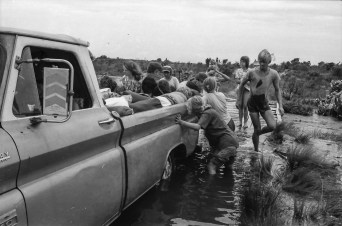 everyone but the drivers of the vehicles and their spouses started walking. By this time I think I was a bit numb as, in spite of the reality that the number of fallen trees kept increasing the closer to town we got, I kept
 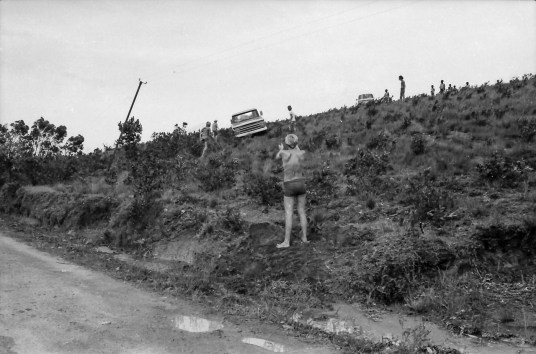 wondering why no one from our school had driven out on the road to pick us up (though how I thought they knew to do this, I’m not sure). I remember walking around, up and over and under trees. As we walked by many houses which had been blown over, the Malagasy who
  watched us walk on by greeted us as if nothing had happened.
At the base of Bezavona, the hill just on the edge of town we were finally back on blacktop for the last several km. And, as there were fewer trees growing along the road, there were fewer fallen ones in the road.
And then we came around the corner where the road suddenly ran along the ocean for the last km into town and I realized that rather than facing the brunt of this cyclone, it had actually just skirted us! The first thing I noticed
was the metal telephone poles, bent sideways to the ground. And then, looking towards town, it was quickly apparent that there was much damage to Fort Dauphin, with many roofs clearly missing. Still hoping that the Trano Vato (the boarding home most of the kids at our school liv ed in) was not too damaged, we saw how wrong we were in this hope as we walked up the stairs to the yard in front of it. And there, in front of us was half of what we knew as the Big Tree on the ground, having snapped off half-way up
its 30 or so meters. And the Trano Vato? It looked like a bomb had gone off. Not only was most of the roof missing, but quite a few of the pillars that had held up the roof over the porch were destroyed as well.
Saying goodbye to my classmates, my brother and I wal ked to our house, only to find the second story of it mostly gone. Partly due to the ferocious winds, partly due to a whole lot of termite damage that hadn’t helped. At all. We found our folks in the midst of beginning the clean up. One of the unusual things we found in doing this was a piece of the stained glass window from the Catholic cathedral some 1 km. away in the window sill of a window on the opposite side of the house from the cathedral. Also, some time during the night the walls at one of the corners of our living room of our wooden house (brought prefab from Norway on a sailing ship some 100 years earlier) had “breathed out” at the corner, trapping one of the curtains between the two walls. But without a roof over our heads, we ended up having to move out for several months while our house was rebuilt.
The next morning I rode bike out to where the vehicles and drivers were still stuck. On the ride out the Malagasy along the road helpfully told me the road north was blocked by fallen trees. Smiling at them, I answered, “I know.” And kept riding, in the end carrying my bike over sections where there was no way around the trees in the road. By this time our 3 cars were some 10 km. closer to town due to a bus which had overtaken them, with sev eral of the passengers having cleared great stretches of road with just a couple of axes.
Greeting the folks there, I gave them an update of things in town (a great big mess, but thankfully only one injury–tip of a finger cut off by a slamming door in the height of the storm). I also told them there had been a Coup d’Etat of the government, with much uncertainty due to this as well. And then I told them they needed to walk the several km. to where the road had been cleared from the other side and one of our other vehicles awaited them.
Riding back to town, all of the Malagasy along the road confirmed with me that the road north was in fact blocked.
“I know,” I smiled back at them, thinking more than one of them must have said (or at least thought), <<Adala ny vazaha!>> (“these white folks are crazy!”
Thinking of the implications of having tried to camp out in a hurricane, I could only agree with them by this point in time!
[the pictures in this blog were taken by Jonathan Barker]
Pauly was a Malagasy man who came to our door in Fort Dauphin,  Madagascar about once per week to sell us bananas. He was short, wore a straw hat and an old sport coat my dad had given him over his short pants. He’d set out early morning in the dark from his village of Anka, nestled up against the foothills about 10 km from town, carrying his bananas in a big, woven twig basket he carried on a pole over his shoulder. Arriving at our doorstep about breakfast time, he’d cough gently outside our door until we came out to see him. He’d greet us with a smile, holding up the bananas he’d brought for sale and then setting them on the porch as my dad or mom picked out the ones they wanted, bargaining only enough to be polite.
Pauly was also one of the elders of his church in Anka. I’m not sure how it 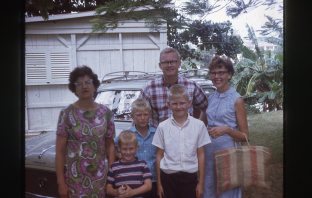 happened, but I’m assuming one year he invited us out to his church for the Christmas Eve service. So we set out late afternoon in our little Peugeot 403 white sedan, mom and dad in the front, us 3 boys in the back, driving over a bumpy red dirt road that led through the lush, green countryside that existed between the ocean and the hills just north of town. About 20 minutes drive Fort Dauphin we headed west on a much less impressive track that headed towards the hills. While we didn’t go very far on this,
  the road wasn’t very good, so dad carefully chose where to drive to miss the biggest holes and rocks. It was getting dark as we pulled into the edge of the little village that was Anka. We were met by what seemed like the whole village, who walked us over to the small thatched church, its walls and roof made from the dried leaves of ravinala plants.
As the honored guests, we were told to sit on some of the few pews in the front of the church along with several of the church’s elders and the Catechist would would be leading the service, as a pastor only came by  once a month or so. “Pews” was a bit of an exaggeration, as they were simply raised poles, uncomfortable to the point that after a while, we boys would sit on the woven straw mats on the floor instead. The rest of the congregation, except for a few elders and the Catechist, sat on straw mats on the floor. Being near the front of the church, we were next to the Christmas tree which was decorated with the first page of Christmas cards, attached to the tree as decorations.
The closest electricity was back in Fort Dauphin, so the church was lit by 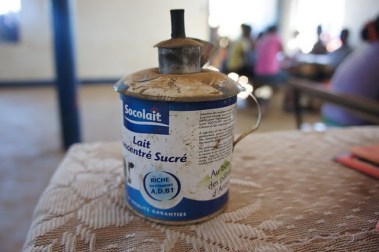 several lamps which had been fashioned out of sweet milk cans. They were held up by parishioners who would pass them off to someone else as they grew tired of holding them. We were still waiting for members of a nearby congregation to join us, so as we sat there, people would say a number, like “254” for example. After a brief paused, everyone gathered would sing, with gusto, hymn 254, all verses, all by memory, as there wasn’t nearly enough light in the church to see the words in the hymnals which was only a problem for those of us who didn’t know the hymnal by heart.
And then between songs, we heard singing off in the distance. I was fascinated to listen to the church’s youth group, having gathered at the other end of the village, walking over to us waiting for the service to begin, sin ging Christmas Carols as they came. Before long they joined us in the church, which now was so full some had to sit outside. And then the service began in earnest. Songs, prayers, eventually a sermon given by the
Catechist, it went on for several hours. At the end of the service we handed out some hard candies, the only “gifts” the kids were going to be receiving that year.
And then, after lots of hand shaking and thanking us for coming, we got back in the car for our ride home.
A Christmas Eve I’ll never forget.
One time in Madagascar, while visiting Manambaro, a small town about
25 km west of Fort Dauphin, I was walking with my colleagues down the main highway just outside
of town, looking at a project request that turned out to be way beyond our capabilities.
As we walked along, we saw a whole lot of m
en coming down the road at a run, singing as they ran, which ended up looking more like a dance as they grew closer. We could see several were carrying big baskets on poles over their shoulders  (one basket per man). As they came alongside us we were able to look into the baskets and saw several with rice, newly harvested and just threshed. They were carrying their <<vokatra>> (“harvest”) home to be dried and eventually sold and/or eaten. On the other hand, there were a lot of men and not nearly a
 s many baskets of rice. There had been a drought that year and so the men were singing at least in part because they were happy to have gotten any harvest at all.
And there, right in the middle of it all, was a good friend of my family, a man who was now a retired school administrator, having been a teacher before this. Though by this time no longer a young 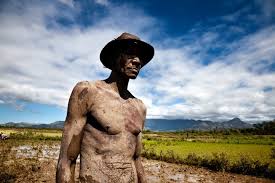 man, he was running along with these men, his friends, accompanying them on their way home. He stopped briefly to greet us.
It had been a very dry year in that part of Anosy, so we told him we were actually surprised to see any rice at all from this year’s harvest! He laughed and said indeed the <<vokatra>> had been very poor, that there had only been enough water for one of his rice fields to have any crop. That he was coming back from 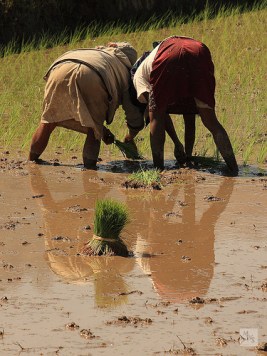 having divided up the little harvest he’d gotten with the men and their sons who had helped repair the irrigation ditches and prepare his fields several months earlier (in that part of Madagascar this is done by chasing cattle back and forth through the mud of the flooded fields–exhausting work) and threshing, their wives and daughters having helped with transplanting the rice seedlings, harvesting and transporting it to the threshing site (all done by hand).
So now, having divided the the <<vokatra>> up with those who’d helped him get it, he admitted he’d probably not have much crop at all left for himself once it had all been divided out. While 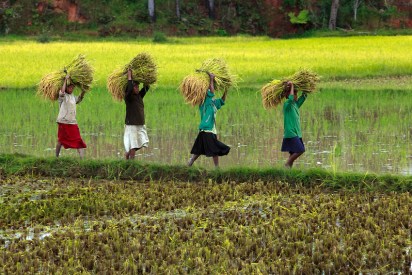 this didn’t mean hunger for him and his family (by this time he was the oldest living royalty of his clan so he had other resources), it did mean none of what was theoretically his crop was heading home to his house.
And then, with a big smile, he said he had to catch up with the other men and ran off to rejoin them.
My kind of royalty! And quite a legacy!
That continues to live on, now long after his death.
My junior year of high school in Madagascar we drove up about 2 hours 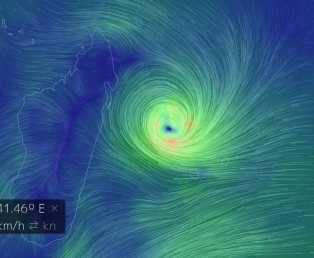 north of Fort Dauphin to do the annual camping weekend at one of the most beautiful coves in the world–Manafiafy. It was hot and muggy, which was common that time of year. And, while I can now see the current (as in right now!) wind conditions in Madagascar from here in the US, back in those days the weather service wasn’t up to this level of prediction. What little we did hear about the weather came over the local radio.
So when the wind suddenly picked up in the middle of our first night of
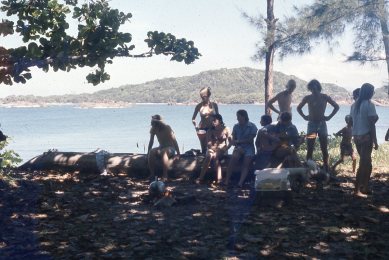
beautiful cove where we camped
camping out, we didn’t think much of it. Then it started to rain, which was a bit problematic, as we didn’t have enough tents for everyone (our assumption was that if we were camping, then it was not going to rain). So I moved my sleeping bag to under the tailgate of one of the pickups we’d driven up in. This was fine until the wind increased and the rain started to move in a sideways direction at which point I abandoned this attempt.
By the time we realized we had a bit of a storm on our hands, the wind had 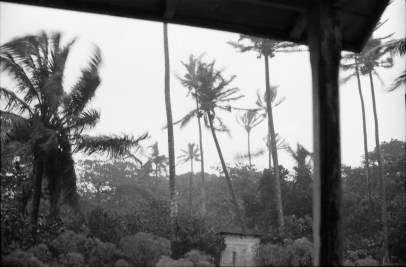 increased greatly. As we began to shuttle folks from the cove to an old Missions guest house several kilometers away (in just one VW bus as we didn’t want folks riding in the back of the open bed pickups we had by this point), the wind went from a lot to a really blowing hard. Before long it
had blown down the tents where folks were staying till they could be shuttled away from our camp site. The one tent, which, wet as it was by this point, must have weighed 100 pounds or more ended up halfway up a tree, held up just by the force of the wind. It took a whole bunch of us pu
lling on it before we could get it collapsed down on the ground. And by this time the rain was coming sideways with such force that it hurt when it hit you.
Mean time the shuttling of people kept going on, till everyone finally was in the old mission house. After we got there, we had several gusts which were strong enough so you could feel the whole house sway and shudder a bit.
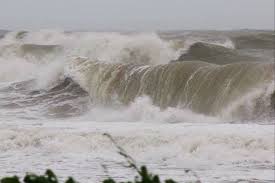 The next morning several of us walked down to the beach, hanging on to palm trees to keep from being blown over as we watched waves going sideways to the beach, something I’d never seen the ocean do.
And then the person who had done the shuttling of folks woke up, asking where he was and how he’d gotten there? He had taken a muscle relaxant the night before for a bad back and did not remember anything that had happened (knowing this, we did have someone ride with him back and forth on the shuttle runs).
After breakfast the wind had died down to almost nothing, so we headed back to the camping site, only to find the road we’d used the night before


blocked by the steeple of the local church, with a giant several hundred kilo bell right in the middle of the road. As we worked to create a detour we asked the Malagasy who came to help when this had happened? “Oh,” they said, “not very long
after the last vehicle went by last night.” That would have been our last shuttle run, as we had the only vehicles in town.
Getting back to the camp site, we loaded up our collapsed tents and 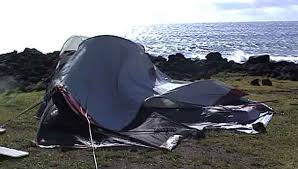 wet camping gear, managed to get the pickup going that wouldn’t start the night before by pushing it and then headed back home to Fort Dauphin, thinking we had quite the story to tell.
We had no idea.
(see part II)
This was a big question for me growing up. Now that I’ve been one for a  while, not so much. But I remember a discussion I had one day now some time ago when this came up. There were 4 of us men present, 1 who had worked in Papua New Guinea (PNG), 1 from here in the US, myself who had grown up and then worked in Madagascar and finally an Ethiopian-American. So in response to the question of when a boy became a man, the person who’d worked in PNG said in that country it happened about the time hair started showing up under one’s arm. Our friend from the US postulated it probably started at 16, when someone got their driver’s license and then progressed through additional rights which accrued when one turned 18 and finally was official at age 21. Then our friend from Ethiopia joined in, saying that in his country, one didn’t become a man until age 40. “Not till 40?” we replied, how does that work? “It’s just the way it is,” he said.
Reflecting on this, I’ve since embraced the Ethiopian perspective. Why?  Because it allows me to take all those stupid things I did before age 40 and lump them into the “I was still not a man at that point” category. Dumb things I did as a husband, new and then not so much, “Still not a man!” Mistakes I made as a dad? “Still not a man!” And now, as I work to raise my “boys to men,” if things don’t always progress as planned, it’s also “Still not a man.”
A little more seriously, I’ve found becoming a man to be a very complex thing, something that takes some getting used to, that I’ve had to work on over time. And raising “boys to men” (our 2 sons), even more complicated. So I now embrace the Ethiopian concept of what’s involved in becoming a man!
With more than a little relief.
I was blessed to be able to sit at the feet of Dr. Paul Hiebert several times  in my life. He was an MK from an India (born there) who became a pastor, missionary (back to India) and eventually anthropologist and then missiologist. One of the topics he shared one of the times I heard him speak was on leadership.
Many leaders, he said, are more like banyan trees in the leadership they provide. While providing their leadership, they may accomplish great things, much like an ever expanding banyan tree which can provide much needed shade over  a very large area. While they’re alive. However, when a banyan tree dies and its leaves are gone, it leaves a barren spot where it was.
On the other hand, he said other leaders are much more like banana trees. Not nearly as large or impressive to look at, but they are oh, so productive, with new banana trees sprouting out from where the original banana tree started.
In the leadership you provide, be like banana trees, he said.
One of the better stories I’ve heard regarding timeliness (or the lack  thereof) is about a missionary desperately trying to catch a train from somewhere to somewhere else in India. It hadn’t been a good day, as he’d been late getting going, then had not one, but two flat tires on his ride to the train station.
Finally, arriving at the train station, he was dismayed to see the train about to leave. Grabbing his bag, he took off at a run, hoping against hope he could still make it. However, while initially he gained on the train, as he continued to run it was clear the train was gaining speed while he was losing it. As he continued to run, the conductor came out on the back of the train and watched him slowly losing his race. But, then, with a big smile he yelled out, “Not to worry, sir! This is yesterday’s train!”
Christmas in Antananarivo, Madagascar brings back many memories. Hot  and humid days (some of the hottest of the year), rains which fell so hard it sounded like they were going to come through the tin roofs, flooding the lower part of town, the markets full of fresh fruit. There were a few Christmas decorations and presents in some of the stores, but not much in the way of Christmas music (outside of the almost nightly Christmas programs).
But one of the interesting things about Christmas in this far off land was 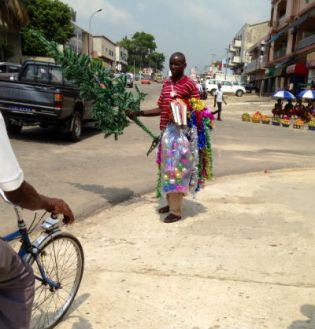 buying a Christmas tree. Where we lived, near the center of town, there were Christmas trees for sale outside the front of Prisunic, the only big store (2 floors! with an escalator! that sometimes worked!) in town back in those days. However, unlike here in the US where there’s generally just one or two people selling a whole lot of trees, in Madagascar, each tree came with its own salesperson. However, to just look at the state of things, it often looked more like a pile of trees than anything else.
However, walking in the direction of these trees (across the street from Prisunic by the taxi stand) resulted in all of the trees on sale that day suddenly coming to life and running at you full speed, each with its own spokesman holding it out in front of them, with just their feet visible below the tree, telling you as they ran at you what a wonderful tree it was, what a good deal it was, how fresh it was and on and on. Seen from afar, it literally looked like a small forest that went running back and forth in the road in front of Prisunic, running towards the potential clients who approached these aggressive salesmen. Up close and personal, it was more than a little intimidating to suddenly have 10 0r 15 pine trees in your face, the salesman’s face peering around the side of them. For further emphasis, once the salesmen were upon you, they’d pound the base of their trees on the pavement as they told you what a great deal it was, how fresh it was, etc. And not only that, but once you had settled on a tree, much to the disappointment of the other salesmen, the more assertive ones would then trail you with their tree, encouraging you to buy another one!
some of you have already read my tale of the Bishop’s socks. let’s just say it was an eventful visit when the Bish op ate lunch with us back then when we were living in Madagascar, as there’s another story to share as well, this one having to do with his chair.
when living overseas in missionary housing, one can end up with a variety of furniture, some of it just fine, some not so much. so you can maybe imagine our dismay when, having arrived at our house for lunch, the Bishop of the ELCA ignored my careful shepherding and hinting (you can hardly just shove this sort of a person out of the way unless what they’re doing is life-threatening) and chose to sit in the one chair we really didn’t want him in. while fairly low to the ground, it was a fine enough looking chair, in appearance quite comfortable. only the straps that held up the seat cushion had broken at some point. insofar as replacement ones were not to be found, some enterprising soul had switched out the broken straps with bicycle tire tube. flexible? yes. rigid enough to do the job it needed to do? hardly. which meant the chair looked just fine with just a cushion over the top of this jury-rigged system. sit on it, however, and, unless you barely weighed anything at all, you just kept sinking down, down, down. we knew this and so tried to always keep visitors from sitting in it, having one of us instead occupy it whenever we had company. and when no one was visiting, we carefully avoided it, realizing it was there much more for show than for actual use.
but here i was, sitting across from the Bishop, having ended up in the chair i had tried to get him to use, watching as he sat down, sinking lower and lower, wondering if there was enough oomph left in the bicycle tube straps to 1) not simply break and, barring that, 2) hold our Bishop up before he reached the floor? having just made a mess out of the whole socks thing (see my previous post), i pondered the implications of following up on this with having the Bishop ending up in a collapsed chair in our living room not 5 minutes later? not good, i thought. who knew entertaining the Bishop could be fraught with such perils?!
my wife and i held our breaths, only starting to breathe normally again when the straps leveled out, just over an inch from the floor. the next torture then became wondering if the tire strips would hold him up until lunch was served? he was a good-natured soul, laughing easily, which, as it caused him to bounce up and down, coming within just a half-inch of the floor, did nothing to allay our fears. and there also was the whole issue of whether our Bishop would be able to extricate himself from the rather deep hole he had unwittingly sunk into?
in my entire life i’ve never been so relieved to successfully move everyone over to the lunch table! and no, we didn’t let him sit in that chair ever again.
 tomberkas